Categorization According to Drinking Water Requirements
The categorization approach was obtained under a strict review of different regulations from different countries analyzing the turbidity, color and nitrogen parameters.
The color and turbidity data were used to estimate the amount of maximum suspended solids. For their part, the various forms of nitrogen were grouped to find the maximum amount of nitrogen allowed.
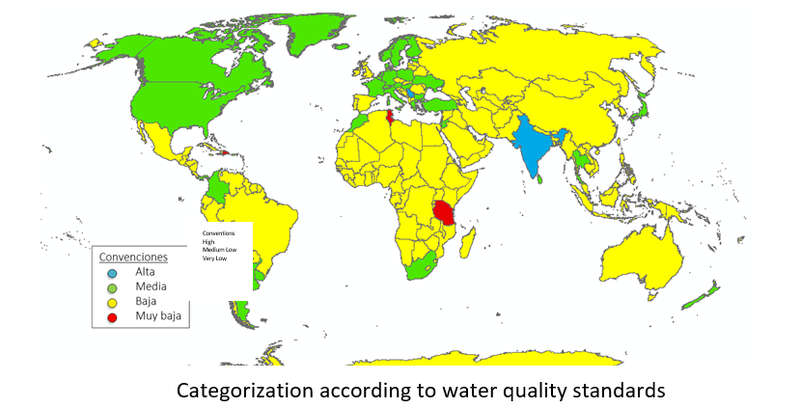
With the data of each country the following categories were created:

High category
It corresponds to the most demanding category, in which countries have imposed much more restrictive regulations. In general, plants in this type of country require more complex processes in order to ensure water within the required parameters.
Normal category
The countries in this category have developed regulations somewhat more demanding than those proposed by the world health organization (WHO). They do not require such complex processes, but even for regular sources they may require conventional treatment to ensure that the quality of the water produced is within the regulations.
Low category
In this category are the countries that follow the standards proposed by the WHO, or whose differences are minimal. The water within these regulations in general would not present problems for consumption, in addition to requiring simpler treatments.
Very Low category
Countries in this category have fewer demanding regulations than those recommended by the WHO. Due to this, it is possible that in certain cases certain health conditions may occur and will require simpler treatment processes
The following figure shows the different countries according to this categorization. A categorization by geographical regions would not have been completely efficient, since countries that share borders may have very different regulations.