Treatment Trains
Depending on water quality and regulatory requirements, treatment trains are proposed trains are proposed in seven categories from A to G, where A is the category that requires most treatment processes and G the one that requires the least.
Treatment trains vary in complexity depending on the quality of the water at the source and the regulatory requirements of the country in which they are located. In this sense, the better the water quality, the fewer the number of processes that must be integrated to make the water potable, while the lower the water quality and the more demanding the regulations, the greater the number of processes that must be included in the treatment plant.
Treatment trains vary in complexity depending on the quality of the water at the source and the regulatory requirements of the country in which it is located. In this sense, the better the water quality, the fewer the number of processes that must be integrated to make the water drinkable, while the lower the water quality and the more demanding regulations, the greater the number of processes that must be included in the treatment plant.
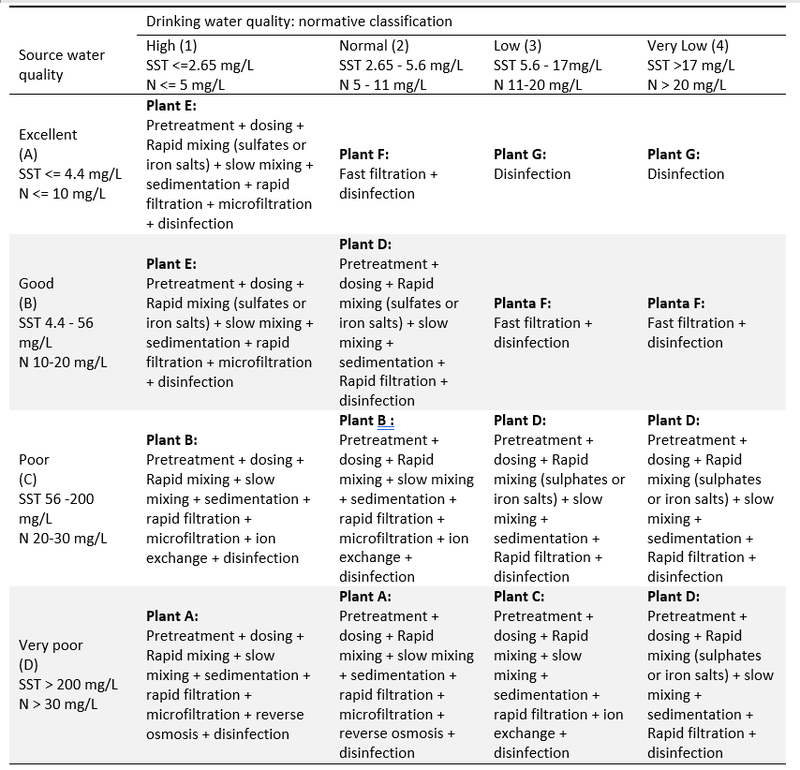
These configurations were proposed to guarantee that the water produced by the plant complies with the regulations of each country, without the need to incur complex and expensive processes when necessary.
Additionally, trains with flocculation (slow mixing) must consider that for flow rates greater than 240 L / s, the installation of mechanical flocculators is recommended.
Plant type selection example
A plant is located in a category 2 country, so its requirement is normal. A very poor source (D) enters the plant and needs to treat 200 L / s. Due to this, a plant configuration A would be recommended, with a pretreatment (ponding or sand trap), a dosing that can be aluminum sulphate, a fast mixing and a slow mixing (both hydraulic), a sedimentation (can be high rate), rapid mixed bed filtration, microfiltration, reverse osmosis, and chlorine gas disinfection. In this case, it would not be advisable to install an ion exchange process as a replacement for reverse osmosis, since there is the possibility that, in the event of an increase in the nitrogen concentration at the inlet, it may not be able to remove the required nitrogen and the quality of the source will not comply with the country’s regulations.