Removal efficiency
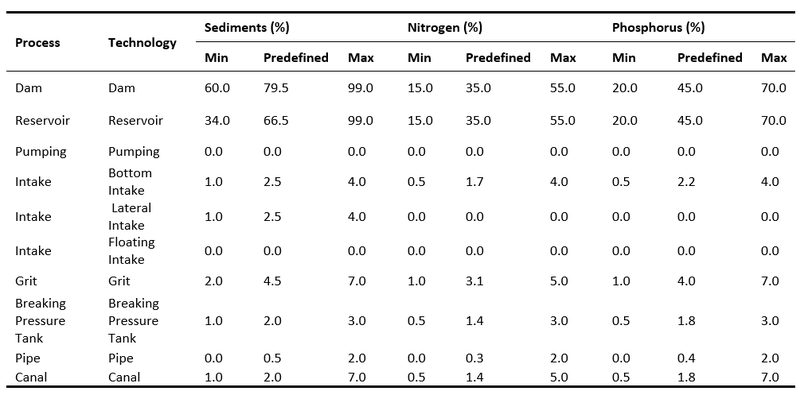
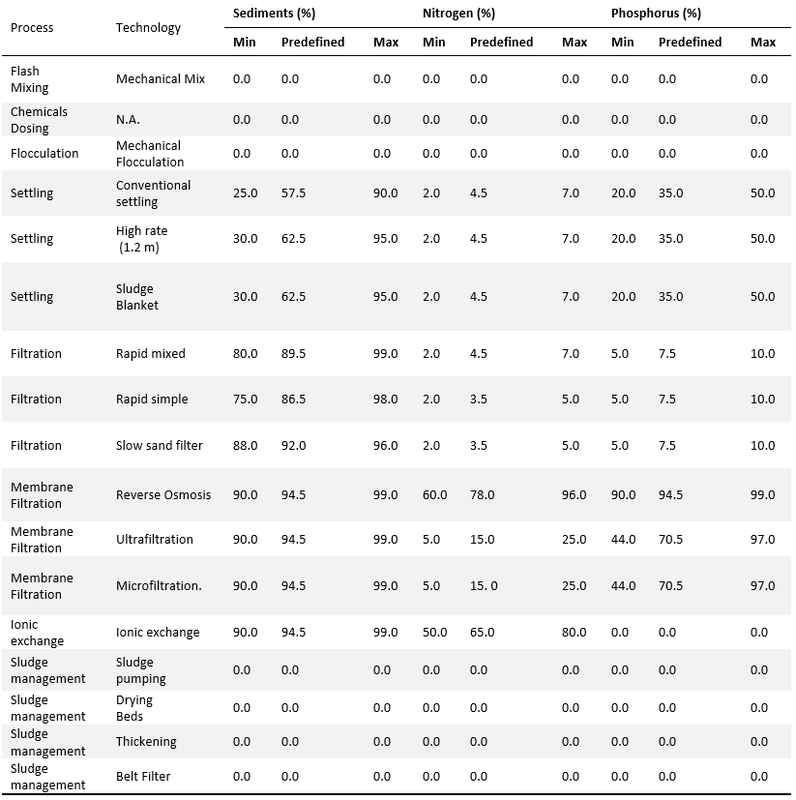
From different sources, the retention percentages are obtained, both the minimum and the maximum of sediments, nitrogen, and phosphorus for each of the processes that are carried out both in the collection and in the water treatment. The predefined percentage shown in the tables is taken as the average of the minimum and maximum percentages.
As can be seen in the tables in some processes, such as pumping, all removal efficiencies are zero, because this process does not retain sediments, nitrogen or phosphorus.
Removal efficiency in the intake related processes:

Removal efficiencies of treatment processes
Share
Bibliography
-
Optimization of slow sand filtration. 22nd WEDC Conference. New Delhi: India.
Nur Muhammad, Ken Ellis, Jeremy Parr and Michael D Smith, WEDC
1996
Documentation carried out to study the influences of sand size, sand bed depth and filtration rates by through laboratory-scale research
-
Color removal fom water by coagulation/caustic soda and lime. J. Environ. Health
Malakootian, Mohammad & Fatehizadeh, Ali
2010
The present study was performed using lime and NaOH as softener agent and for increasing the pH of the process. Alum and ferric chloride coagulants were used to increase the size of flocs in various pH and color removal from water. It was tried to simulate the conditions of water treatment plants. Coagulant and lime doses, initial color and pH were studied. After the process, the residual color, as well as pH and electrical conductivity of water were measured.
-
Total Nitrogen Removal by Reverse Ósmosis: Role of Biodegradable Dissolved Organic Nitrogen. Proceedings of the Water Environment Federation.
Kasi, Murthy & Swanson, Mitchell & Simsek, Halis & Ahlschlager, Steve & Ritterman, Kent & Hausauer, Jim & Hoff, Jeff & Khan, Eakalak
2013
The objective of this study is to investigate the fate of DON and BDON through a RO based membrane treatment plant. Samples were collected along the treatment train of a combined ultrafiltration (UF) and RO membrane treatment plant and analyzed for dissolved nitrogen species including ammonia, nitrite, nitrate, total nitrogen and organic nitrogen.
-
Comparing operational cost and performance evaluation of electrodialysis and reverse osmosis systems in nitrate removal from drinking water in Golshahr, Mashhad
Pirsaheb, Meghdad & Khosravi, Touba & Sharafi, Kiomars & Moradi, Masoud.
2015
The aim of this study was to compare the operational cost and efficiency of electrodialysis and reverse osmosis systems in removing nitrate from drinking water. Eighteen samples were selected to measure nitrate and other chemical parameters. Also, the present cost value and useful life of 15Â years were used for comparing both systems. Results indicated that nitrate removal in the reverse osmosis system was about twice (90) more than that of the electrodialysis system.
-
Impact of pH on the removal of fluoride, nitrate and boron by nanofiltration/reverse osmosis
Richards, Laura & Vuachère, Marion & Schaefer, Andrea.
2010
The objective of this study was to evaluate the impact of pH on boron, fluoride, and nitrate retention by comparing modelled speciation predictions with retention using six different nanofiltration (NF) and reverse osmosis (RO) membranes (BW30, ESPA4, NF90, TFC-S, UTC-60, and UTC-80A).
-
Nitrate removal with reverse ósmosis in a rural area in South Africa. Desalination
Schoeman, J. J., & Steyn, A
2003
The nitrate-nitrogen concentration (>6 mg/l) and the salinity (>1000 mg/l TDS) of many borehole waters in rural areas in South Africa are too high for human consumption. Therefore, an urgent need for water denitrification and water desalination exists in these areas.
-
Evaluation of the physical and chemical characteristics of water on the removal efficiency of rotavirus in drinking water treatment plants and change in induced health risk.
Shamsollahi, H. R., Ghoochani, M., Sadeghi, K., Jaafari, J., Masinaei, M., Sillanpää, M., Yousefi, M., Mirtalb, S. T., & Alimohammadi, M
2019
Rotavirus is one of the main waterborne causes of diarrhoea. Rotavirus type A is responsible for diarrhoea in infants and causes thousands of deaths annually around the world, especially in developing countries. Rotavirus is very small and is highly resistant to common disinfectants, so the World Health Organization (WHO) has chosen this virus as a reference pathogen in drinking water and has recommended a its 6-log removal by the conventional water treatment process to supply safe drinking water. We measured some physical and chemical characteristics of raw water at a water treatment plant in Tehran, Iran, including temperature, pH, total organic compound (TOC) concentration and initial turbidity, to determine their effect on rotavirus removal efficiency in various processes.
References
- Pollutant removal efficiency of a retrofitted stormwater detention pond https://iwaponline.com/wqrj/article/49/2/124/21567/Pollutant-removal-…