Cost functions
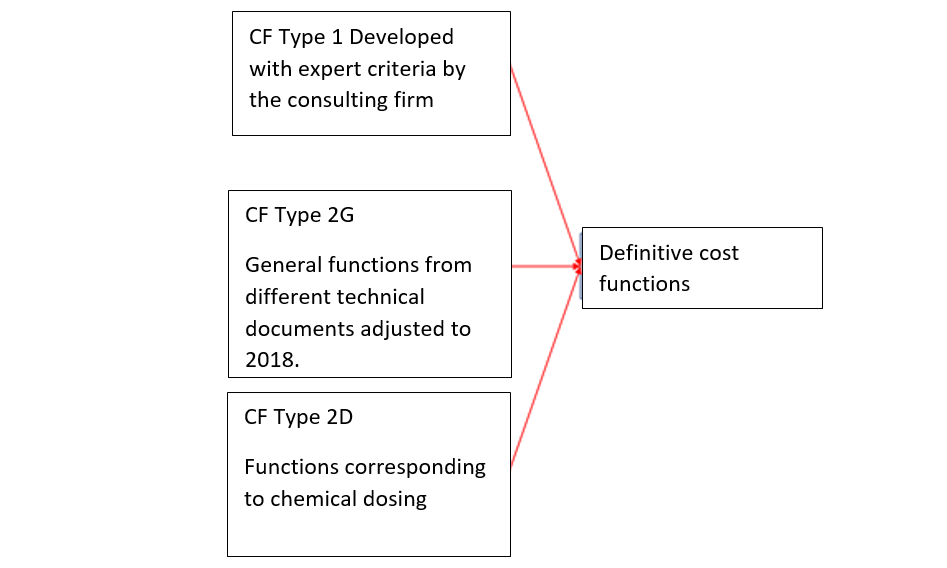
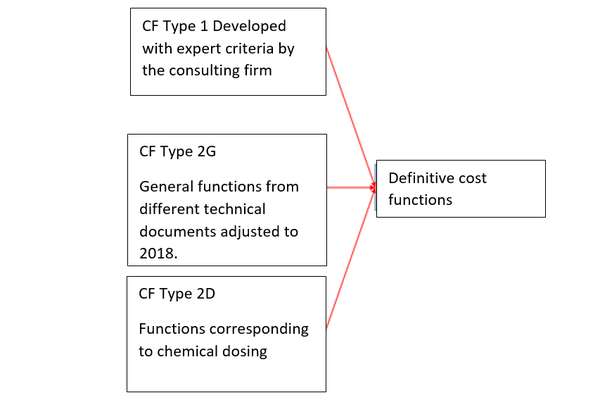
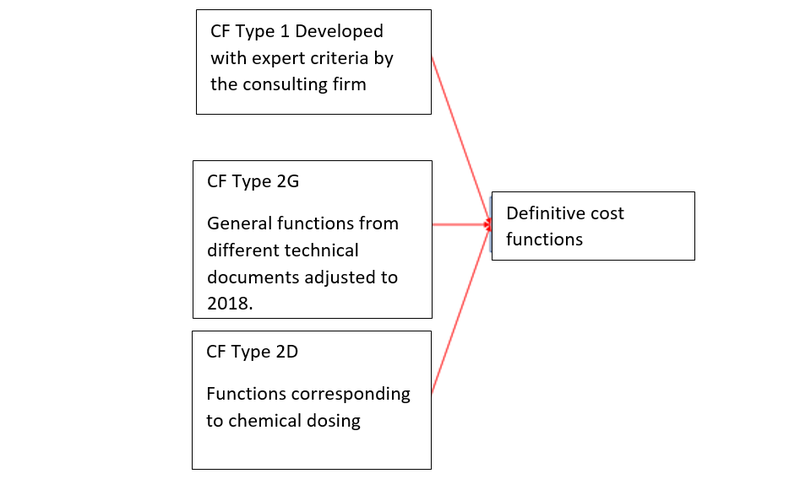
The cost functions that make up this document originate from two creation structures, as follows:
i. the first—which we will call type 1— corresponds to the cost functions that were developed with the support of technical documents and basic engineering concepts, which, together with the experience and criteria of the members of the consultancy, were defined.
ii. The second structure —which we will call type 2— corresponds to the cost functions that were adapted from some already existing ones, present in the specialized literature, through papers, theses, and other popular science documents: general functions —which we will call FC Type2G— and functions of the dosing area - FC Type2D. The former will be explained in more detail below, the latter are explained in the chemical dosing article.
Type 2 Cost functions (general)
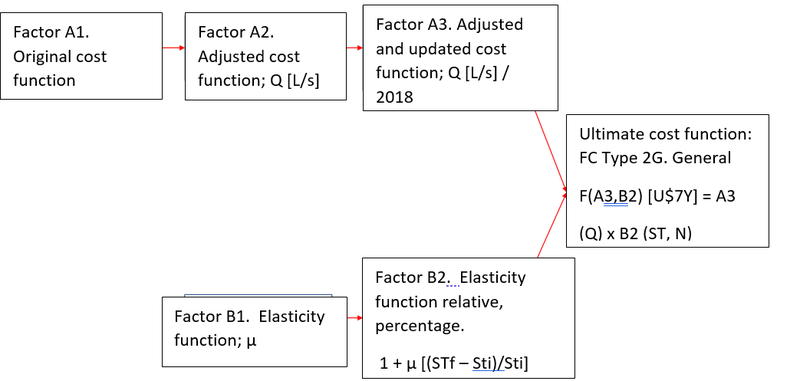
The cost functions developed of this type are based on the integration of elements from different sources and variables. Each cost function is made up of two factors defined as A and B. Each of these will be described below.
Factor A.
Factor “A” is the result of a cost function that has as variable(s) different magnitudes that participate in the process of collecting, transporting, and treating water; flow, area, volume, among others, are part of this cost function, which from now on we will call A1. The A1 (original) functions come from different sources and consequently they also have different units.
Based on the above, and for the purposes of a simplified handling of the function, it is necessary to standardize all the quantities to a single and consequently to a single unit. The most universal selected quantity was the flow, and the selected unit corresponds to liters per second [L / s], in such a way that the A1 functions were standardized —as mentioned above— and are now called A2.
On the other hand, given that the cost functions come from different sources, which in turn are based on different production times, it is necessary to complement the cost function with a factor that allows them to be transferred to a common time base. This factor corresponds to the construction cost index ENR (Engineering News-Record), which allows updating the cost of any A2 function on a defined date, for this specific case, to December 2018. This cost function updated to December 2018 —which includes the ENR factor— is called A3.
Factor B.
Factor "B" corresponds to an adjustment by coefficient of elasticity, which has as variables concentration magnitudes that participate in the same processes mentioned in type "A" functions. The characteristics of the water that make up Factor B are: Sediments and nitrogen; sediments are evaluated through the concentration of total solids and nitrogen through the sum of their different forms found in nature: nitrates, nitrites, ammonia, among others. This factor, with the characteristics mentioned above, will be referred to as B1 from now on.
To properly use factor B1, it is necessary to define a baseline concentration of total solids ST and nitrogen N. The selected base values are: 203 mg / L of ST and 30 mg / L of N; mean values of the raw water quality categories (see Raw Water Wiki). These values are the reference, to find the percentage variation of each of these characteristics of the water of the place where the cost function is applied. In such a way, that with the aforementioned factor B1 is renamed B2.
Note: Each of the factors mentioned above (A3 and B2) are duly developed for the cost functions that are presented in the following Wikis: they can be adjusted or updated based on the steps mentioned. For the case of A2, this is explained in more detail in each Wiki.