Mass Balance
In order to obtain the cost benefits in the different structures of the catchment and treatment systems, a mass balance is carried out to analyze the costs associated with the amount of sediment, nitrogen and phosphorus that enter and are retained by each element.
Each element has an associated sediment, nitrogen and phosphorus retention percentage, which is understood as the operating efficiency of that element. The algorithm takes balance of the water received, applying these percentages, affecting the quality of the water which is delivered to the next element of the structure.
This determines the quality of the water, in each of the elements and and the amount of particles retained. This is necessary to analyze the costs involved in keeping the catchment or treatment system running, which is required to calculate the ROI.
The modeling components of WaterProof include the solution of mass balances between the different components of the drinking water collection, distribution and treatment systems. Each element is identified by a unique numerical code, with a positive value greater than or equal to 1. Zero is reserved within the code, so it cannot be used as an identifier. For ease of use, in WaterProof, the catchment schemes must always start with an element called river, then to this, the other elements that make up the system are connected. Since each element contains a unique code, the topology (connections between elements) can be represented as the set of pairs of contiguous elements arranged in a matrix arrangement.
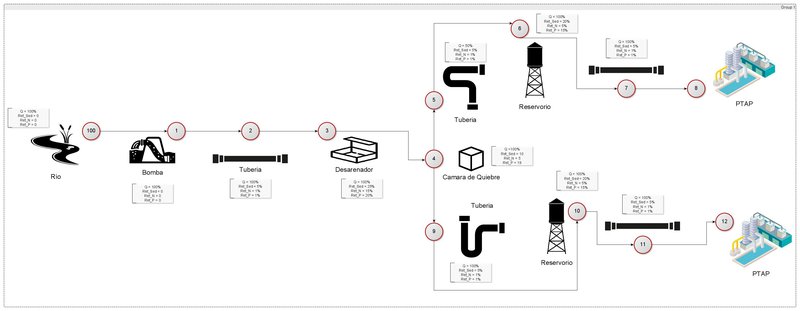
Ilustration1. https://github.com/The-Nature-Conservancy-NASCA/Water_Balance